
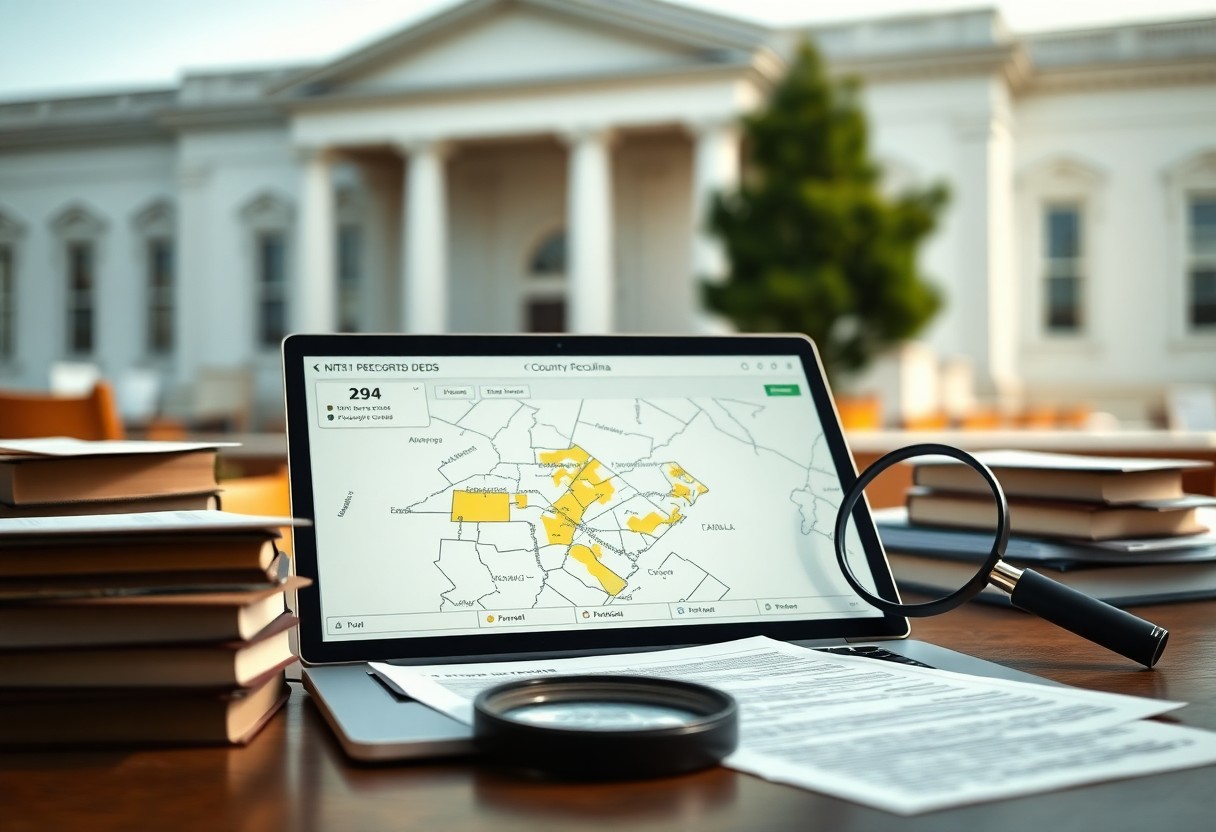
It’s possible for you to uncover property ownership histories, liens, and tax records using a North Carolina parcel search, giving you clear evidence for title questions, boundary issues, and transaction due diligence.
Navigating the North Carolina Land Record Landscape
Records held in courthouses and online public portals give you access to deed chains, easements, liens, and recorded surveys so you can verify legal ownership, uncover title issues, and plan next steps confidently.
The Role of County GIS and Tax Assessor Databases
County GIS maps and tax assessor records let you view parcel boundaries, acreage, zoning, and assessed values while cross-checking ownership names to spot mismatches before ordering deeper title searches.
Understanding Parcel Identification Numbers (PIN) and Legal Descriptions
PINs act as unique numeric keys you use to pull property data quickly; legal descriptions then confirm metes, bounds, or plat references so you match records to real-world parcels accurately.
Details in legal descriptions-lot numbers, subdivision names, bearings, distances, and recorded plat book/page-help you reconcile mapping errors and resolve ownership ambiguities when PINs point to conflicting entries.
Tracing Property Ownership and Historical Deeds
Records at county offices reveal previous deeds, easements, and transfers so you can chart ownership changes and spot anomalies that signal title issues.
Identifying Current Title Holders and Beneficial Interests
You should check current deed names, mortgage records, and recorded assignments to identify legal titleholders and uncover beneficial interests held through trusts or LLCs.
Researching the Chain of Title through Registry of Deeds
Search Registry of Deeds indexes, grantor-grantee books, and digital records so you can trace each conveyance, noting liens, covenants, and gaps that affect your title clarity.
Examine original deeds, plats, and probate files at the registry so you can verify signatures, legal descriptions, and recorded easements; build a chronological chain, flagging breaks, unrecorded transfers, or clerical errors that could cloud ownership and prompt title insurance or legal review.
Evaluating Property Valuation and Tax Assessment Data
Assessments give you baseline figures to compare against market prices and reveal valuation gaps that may point to unrecorded improvements or recent transfers affecting ownership clarity.
Analyzing Assessed Value vs. Market Trends
Comparing assessed values with recent sales and neighborhood trends helps you detect discrepancies that could signal misvalued parcels, potential title issues, or investment opportunities tied to ownership changes.
Reviewing Property Tax Status and Delinquency Records
Checking tax status reveals whether taxes are current, delinquent, or in foreclosure, which can indicate abandoned properties, pending sales, or disputes that impact ownership claims.
When you examine delinquency records, you can track liens, tax-sale notices, and redemption periods to assess risk and timing for possible acquisition. Looking through payment histories and county clerk filings helps you identify contested taxes or repeated delinquencies that often signal an owner under financial strain or an unclear title requiring further title search or legal review.
Decoding Physical Boundaries and Geographic Features
Maps let you confirm parcel lines, adjoining properties, easements, and access points using county parcel overlays and survey data.
Utilizing Interactive Mapping for Boundary Verification
Interactive county maps allow you to toggle layers, measure distances, and compare recorded boundaries with satellite imagery for immediate boundary verification.
Interpreting Topography, Flood Zones, and Soil Data
Topography, flood-zone maps, and soil reports show you slope, drainage patterns, and hazard exposure that affect buildability and insurance considerations.
Analyzing contour intervals alongside FEMA flood maps lets you gauge seasonal inundation risk, while soil survey data and borings reveal bearing capacity, permeability, and erosion potential; you can combine these findings to site structures, plan drainage and septic systems, estimate foundation needs, and anticipate permit or mitigation steps.
Uncovering Encumbrances and Land Use Restrictions
Inspect recorded deeds and county records to spot liens, covenants, or historical restrictions that affect your parcel’s use and transferability.
Identifying Easements, Rights-of-Way, and Public Access
Check recorded plats and title abstracts to identify easements, rights-of-way, or public access that may limit how you use or build on the property.
Verifying Zoning Classifications and Development Limitations
Confirm zoning designations and overlay districts with county planning maps so you understand permitted uses, setback rules, and density limits before you plan changes.
Review local zoning ordinances, maps, and overlay rules to determine permitted uses, conditional uses, and specific development standards that affect your project; ask the planning department for official interpretations, request a zoning verification letter when needed, and evaluate whether variances, special permits, or rezoning will be required for the changes you want to make.
Advanced Search Strategies for Complex Ownership
Advanced search tactics combine deed tracing, instrument filters, and historical indices so you can expose layered ownership, nominee names, and trust structures.
- Trace deed chains by grantor/grantee
- Filter by instrument type and date ranges
- Search trustee and bankruptcy filings
- Match GIS coordinates across records
- Consult assessor splits and plats
Key Resources
| Resource | Purpose |
|---|---|
| County Recorder | Deed books and instrument history |
| County Assessor | Parcel IDs, tax rolls, acreage |
| Secretary of State | Corporate filings and agent records |
| GIS / Plat Maps | Coordinates, boundaries, adjoining parcels |
Cross-Referencing Corporate Entities and Trustee Records
Cross-referencing corporate filings, trustee deeds, and secretary-of-state records helps you connect shell entities to parcel records and reveal beneficial owners.
Utilizing Multi-County Searches for Large Land Holdings
Use multi-county indices, plat maps, and tax rolls so you can trace contiguous holdings, spot split parcels, and align parcel IDs across jurisdictions.
When properties span counties, compare deed book/page citations, parcel ID formats, and GIS coordinates to match records; you should pull assessor maps, historic plats, and survey notes, then reconcile legal descriptions and acreage. Expect naming variations and clerical errors, so verify metes-and-bounds and recorded easements to confirm true ownership across borders.
Summing up
Considering all points, you can use a North Carolina parcel search to uncover ownership history, public records, and boundary details, but you should verify deeds and liens with county offices or a title professional for legal certainty.